A Guide to Iceland’s Mountain Huts
A hikers’ guide to Iceland's well-beloved mountain huts — how to book, what to expect, what to bring, about our favorite Laugavegur huts and beyond.
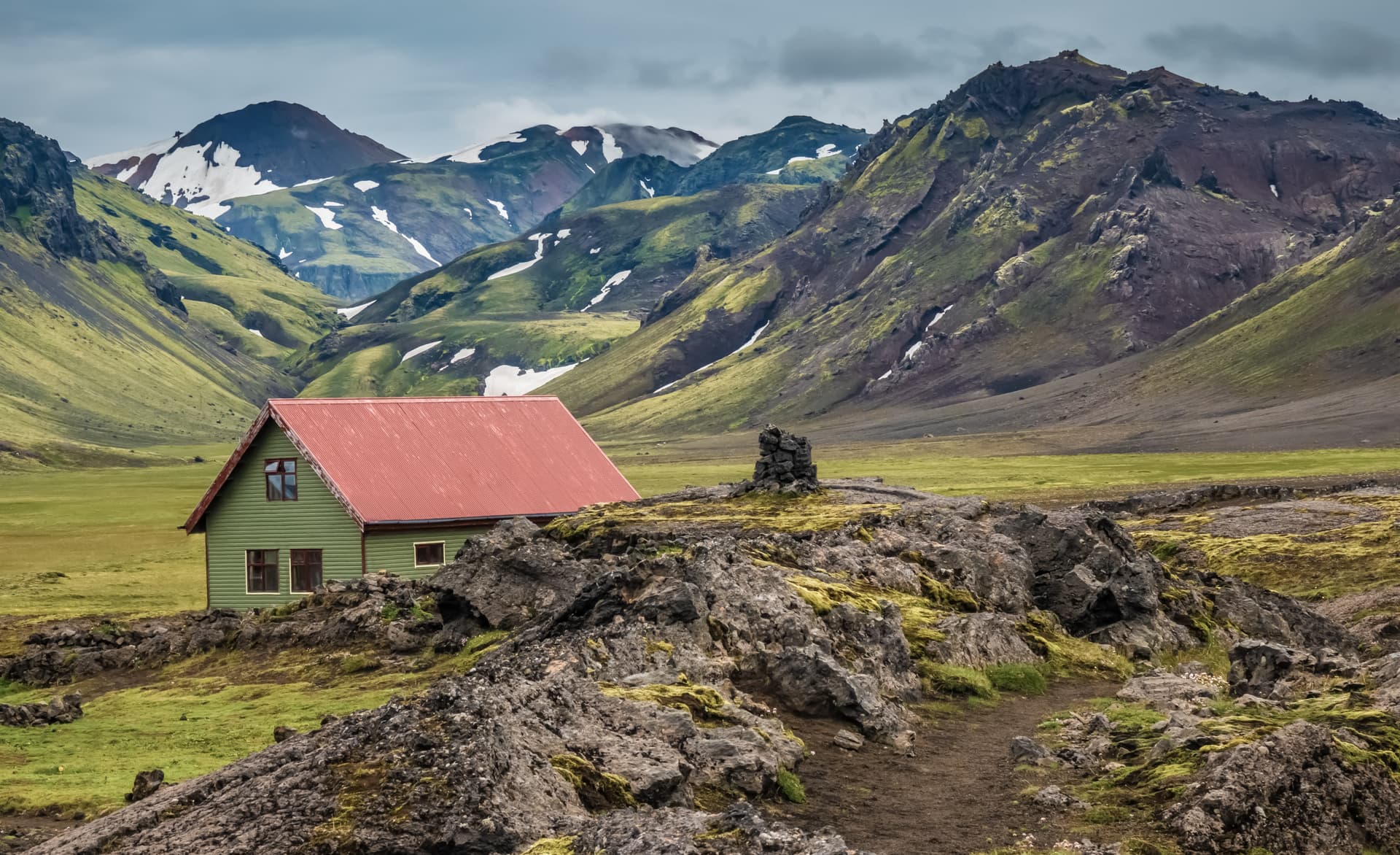
Picture this: it's 19:00 when you reach the Álftavatn hut on the Laugavegur Trail. You've walked 12 km from Hrafntinnusker, the last three downhill through cloud. It is summer and the sun barely sets, but the day has caught up with you.
Inside the hut, the warden ticks your name off a clipboard and directs you to your bunk. You take your boots off, cook dinner on shared gas burners to the sound of pleasant chatter, and by late evening you are settled down in your bunk, the hut silent except for the wind.
For anyone hiking off the road in Iceland, a mountain hut is what awaits at the end of each day. These huts sit in remote places — at the edge of an obsidian-strewn pass at 1,100 meters, on the shore of a lake, on a black-sand beach where the next farm is sixteen kilometers away — and they are the reason Iceland's long trails work the way they do.
This guide covers what the huts are, as well as how to book one, what to expect inside, what to bring, and the huts we send our hikers to first.
About Iceland's Mountain Huts
Iceland's mountain huts are basic accommodations designed for hikers and mountaineers. Located in remote areas, these huts offer a mix of essential amenities. Most of them are managed by the Icelandic Touring Association (FÍ).
The huts are typically staffed by wardens who maintain the facilities and assist hikers. Most are open and manned during summer but closed in winter; you can check when each hut is manned on FÍ's official website and pages of other hut operators. Some remain open in winter, but access often requires snow hiking or specially equipped vehicles.
Huts in Iceland range from small ones offering basic facilities like bunk beds and communal kitchens to larger ones with more amenities such as hot showers and dining rooms.
Smaller huts usually range from 12 (Þjófadalir hut) to 20 people, while larger ones can accommodate 30+ people (Landmannalaugar hut’s capacity is 78 people). You can expect to often see a cluster of huts on the more popular trails, one of them usually used by the warden.
Most huts are manned, but self-catered. While larger huts may also sell very basic food and supplies, this will vary from hut to hut. Some larger lodges have stoves for cooking; others require bringing a camping stove.
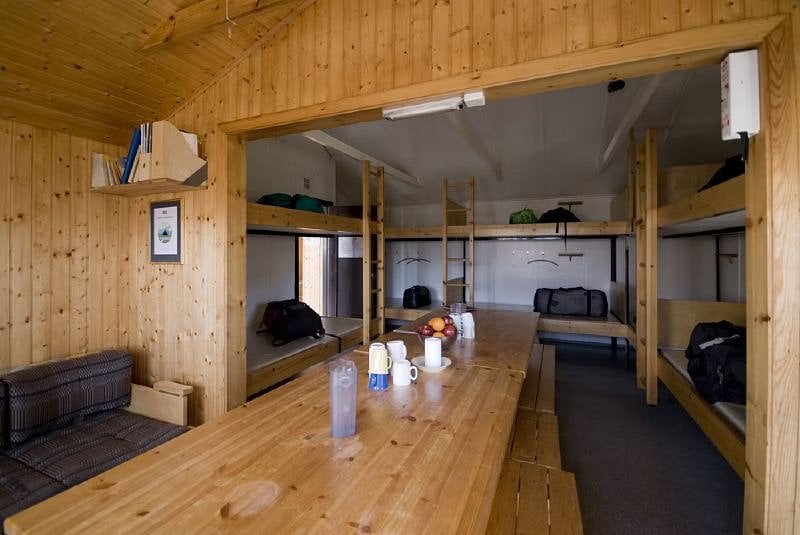
Hikers should bring their own sleeping bags and blankets are not provided. The interiors are moderately heated. In larger huts you can expect running water and flush toilets; smaller ones require fetching water and using a latrine. You can check the facilities of each FÍ hut and Útivist's huts in advance.
Huts are usually booked directly at the organization that maintains them. The most important rule is to do it early. The headline trails — Laugavegur, Fimmvörðuháls, parts of Hornstrandir — fill from the moment FÍ opens the following summer's reservations, usually in late autumn or early winter. By March, July and August are typically gone. By May, June and September are mostly gone too.
Want to skip the booking part? Leave it to us by choosing a self-guided tour.
Hut Rules
Hut rules emphasize cleanliness, tidiness, and consideration. The key ones:
Warden consultation: If a warden is on duty, check in with them about your booking and sleeping arrangements.
Check-in/out: Check-in is between 12:00 and 20:00; check-out is by 10:00.
Quiet hours: Maintain quiet from midnight to 7:00 a.m.
No shoes inside: Leave hiking boots in the entrance hall.
No smoking inside: Smoking is prohibited inside the huts at all times.
Cleanliness: Make sure the hut is clean after cooking and before you leave.
Environmental care: Pack out all trash and help keep the environment clean.
Hut Etiquette in Practice
The rules that might get broken in practice are quiet hours, kitchen cleanup, and wet-gear management. The entrance hall of every hut will be lined with damp jackets and boots by 16:00. Hang yours on hooks, not on the floor; pull them inside before bed if the hut has a drying space.
Cooking is communal in a literal sense. Eight people sharing two burners is normal at peak season. Cook efficiently and wash dishes immediately. Don't leave food in the kitchen overnight, including snacks in your dry bag — the mice find them.
Quiet hours mean lights-out and zipped-bag silence. Headlamp use after midnight is fine; conversations are not. Iceland's huts house people from a dozen countries on any given night, and someone is always trying to sleep at any given hour.
Laugavegur Trail Huts
There are six huts along the Laugavegur Trail, each offering mattresses, toilets, cold running water, and a communal kitchen. These huts are heated but don't have electricity for charging devices. Booking in advance is essential because of their popularity.
To learn everything there is to know about the Laugavegur Trail in more detail, visit our Ultimate Guide to Iceland's Famous Multi-Day Hike.
Hut Amenities
What Iceland's huts provide:
A sleeping platform and a thin mattress (no bedding)
A communal kitchen — gas or wood stove in larger huts; counter only in smaller ones
Cold or warm running water (a stream or barrel at the smallest huts)
Toilets — flush at the larger huts, dry latrines or composting setups at most smaller ones
A warden in summer who handles bookings, sells shower tokens, and knows the day's weather
Heat — usually electric or wood, enough that a midweight sleeping bag is plenty
What they don't:
Sleeping bags, blankets, or sheets
Hot meals or pre-prepared food (a few larger huts sell snacks and basics)
Towels
Reliable electrical outlets for charging devices
Privacy — dorms are dorms, six to twelve people per room
Wifi or cell service at most locations
Secure storage
Most FÍ and Útivist huts share a basic shape. You arrive, change out of your boots in the entrance hall, find your name in the warden's logbook, and are pointed toward a sleeping platform with a mattress.
What to expect
Bedrooms are dorm-style — six to twelve people in a room, sometimes more, separated by partitions or stretches of open bunkboard. Bring a sleeping bag rated to a comfort temperature of 0-10 °C; the rooms are lightly warmed and get even warmer when crowded.
The kitchen is communal. Larger huts (Landmannalaugar, Álftavatn, Þórsmörk's Langidalur and Skagfjörðsskáli) have gas or wood stoves, sinks, pots, and dish racks; smaller ones have a counter and assume you've brought your own stove. Water comes from a tap in larger huts and from a stream or barrel at smaller ones.
Toilets at the larger huts have running water and flush; at smaller huts you'll find dry latrines or composting setups in a separate building outside.
Showers are available at some larger huts — Landmannalaugar, the Þórsmörk lodges — for a small extra charge, usually around 800–1,000 ISK for a few minutes of hot water. Most other huts have none.
There are no electrical outlets for charging devices at most huts; bring a power bank.
FÍ runs a small shop at most of its larger huts — hot drinks, chocolate, instant soups, tinned fish, and at the busiest huts a hot soup of the day. The selection varies between huts and the smaller ones often have nothing on offer, so carry your own meals and treat anything sold inside as a bonus.
Wardens are on duty in summer and are part-warden, part-resource. They handle bookings, sell tokens for showers, and know the day's weather and trail status better than any forecast. They are also the people who will tell you when the trail ahead has too much snow.
What to Bring
A short list of what makes a hut night work, beyond the day-hike kit you're already carrying:
Sleeping bag rated to ~0–10 °C comfort. A liner if you want extra warmth or a hygiene barrier. Note that the huts are lightly heated and can get warm if crowded.
Indoor shoes — light Crocs or camp slippers. Boots stay in the entrance hall.
Headlamp. The huts have lighting; the toilets are often outside.
Earplugs. Dorm sleeping with a dozen strangers is what you make of it.
Quick-dry towel, especially if you plan to use the hot springs at Landmannalaugar or shower at the larger huts.
Cash and card. Some hut shops are card-only, some are cash-only; assume you'll need both.
Stove and fuel if you're traveling huts where the kitchen is bring-your-own. Note that you cannot fly with gas canisters; buy them in Reykjavík (most outdoor shops carry them).
Sandals or water shoes for river crossings on the trail.
For a full packing list of necessities, see our guide on what to pack for hiking in Iceland.
A Day in a Hut
Hut life follows a predictable rhythm, and slotting into it makes everything easier — for you, for the warden, and for the people sleeping next to you.
12:00–20:00 — Check-in window. Most hikers arrive between 15:00 and 18:00.
Afternoon — Settling in. Boots off, sleeping bag laid out, wet gear hung to dry. If the hut has showers, this is when to use them; the warden sells tokens.
18:00–20:00 — Communal cooking. The kitchen is at its busiest, so cook efficiently and wash dishes immediately; eight parties on two burners is normal at peak season. Then maps, cards, conversation with whoever you've ended up sharing a dorm with. Wardens may share the next morning's forecast and trail conditions around this time.
00:00–07:00 — Quiet hours. Lights out, zipped-bag silence. Headlamps for trips to the latrine are fine.
07:00–09:00 — Breakfast and pack-up. Check-out is usually by 10:00; most parties are walking by 09:30.
Camping
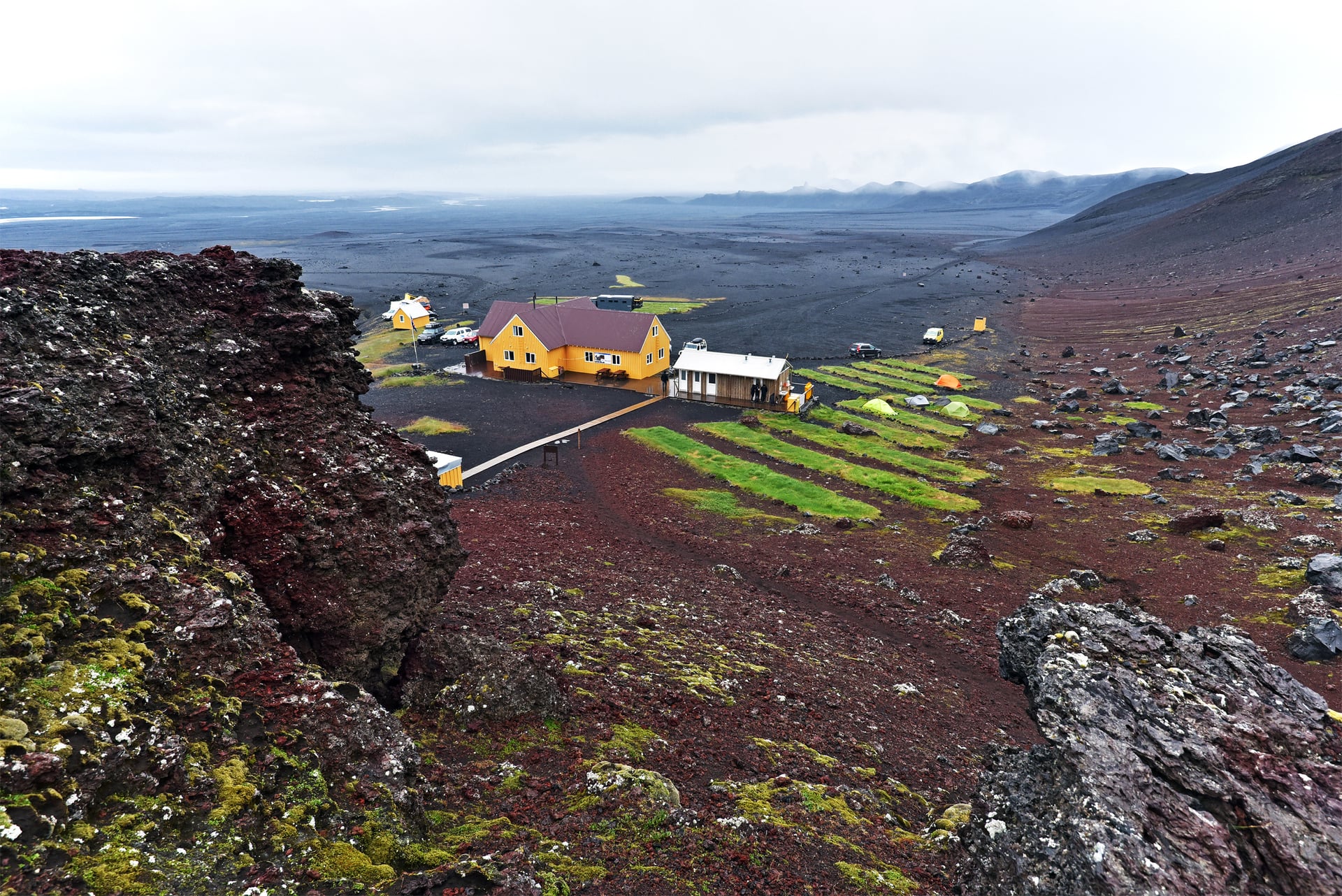
Camping is allowed beside every FÍ hut for a fee, with advance bookings required just like for a bunk. Where permitted, camping is meaningfully cheaper, though it requires you to carry a tent and a full sleep system.
Campers can't use the hut kitchens — bring your own stove — though Landmannalaugar, Hrafntinnusker, Emstrur, and Þórsmörk all have covered shelters for cooking.
Paid showers are available at Landmannalaugar, Álftavatn, Hvanngil, Emstrur, and Þórsmörk, and at Hrafntinnusker, Emstrur, and Baldvinsskáli you must pack your own trash out to the next hut.
Our Favorite Huts in Iceland
Out of 60-70 huts across Iceland, these are the ones we send our hikers to and the ones we return to ourselves. All are reachable on foot from a marked trailhead in summer; some are part of our self-guided tours, all of them are bookable independently.
Hrafntinnusker mountain hut
Álftavatn Hut
Breiðavík hut (Breidavik)
Botnar hut
Guesthouse Rauðafell (Raudafell)
Fimmvörðuháls hut
Húsavíkurskáli hut
Loðmundarfjörður hut (Lodmondardjordur)
Básar Hut
Hrafntinnusker
Capacity: 52
Altitude: 1100m
The first mountain hut on the Laugavegur Trail, sitting at 1,100 meters in a black field of obsidian and rhyolite that gave the place its name (hrafntinna means "obsidian", literally "raven flint"). It is the highest, coldest, and most exposed hut on the route, and from its windows you see what brings most people to Iceland in the first place: snowfields, steaming vents, and ridges of red and yellow rock.
The hut itself is FÍ-standard, encompassing a ground-floor dormitory and a sleeping-bag loft, with a kitchen of gas stoves, utensils, and cold running water. No shower; toilets and sinks sit in a separate building behind the hut, reached by a short walk through whatever the day's weather is doing.
Set 12 km from Landmannalaugar with around 470 m of climb, it's the natural Day 1 stop on any Laugavegur itinerary. Unforgettable views off the eastern terrace at golden hour, when the mist clears and the obsidian glints like wet glass.
Álftavatn
Capacity: 72 (two huts combined)
Altitude: 550m
The second Laugavegur hut, and among the most beautifully placed in the country. Álftavatn means "Swan Lake", and the hut sits directly on the shore at 550 meters, with the rhyolite ridges of the Torfajökull massif behind and volcanic peaks rising in front.
Compared to Hrafntinnusker, it's a comfortable hut: 72 sleeping-bag spots across two side-by-side buildings (40 and 32), a proper kitchen with gas stoves and a dining room, paid showers in a shared toilet house, and mobile connection if you need to reach anyone.
Coming down off the Hrafntinnusker pass and seeing the lake appear through the cloud is one of the consistent emotional moments of any Laugavegur trip — a 12 km day, mostly downhill, ending in the kind of view that justifies the rest.
Breiðavík
Capacity: 33
Altitude: 2m
The most spectacular of the Víknaslóðir huts, on the eastern coast in the chain of deserted bays north of Borgarfjörður Eystri. Set above a long curve of black-sand beach with the rhyolite mountain Hvítserkur visible to the south on a clear day, Breiðavík is a sight to see both when you first spot it, and thanks to spectacular views from its windows.
It includes a basic touring-club setup: bunks, a kitchen, a shower and toilets. There is also a coal grill, but no coals are provided. The walks in and out are the point.
Reaching it means a full day of hiking from Borgarfjörður Eystri or from the next bay along the trail, and the puffin colonies in this region are some of the best in the country in early summer.
Botnar (Emstrur)
Capacity: 60 (three huts combined)
Altitude: 465m
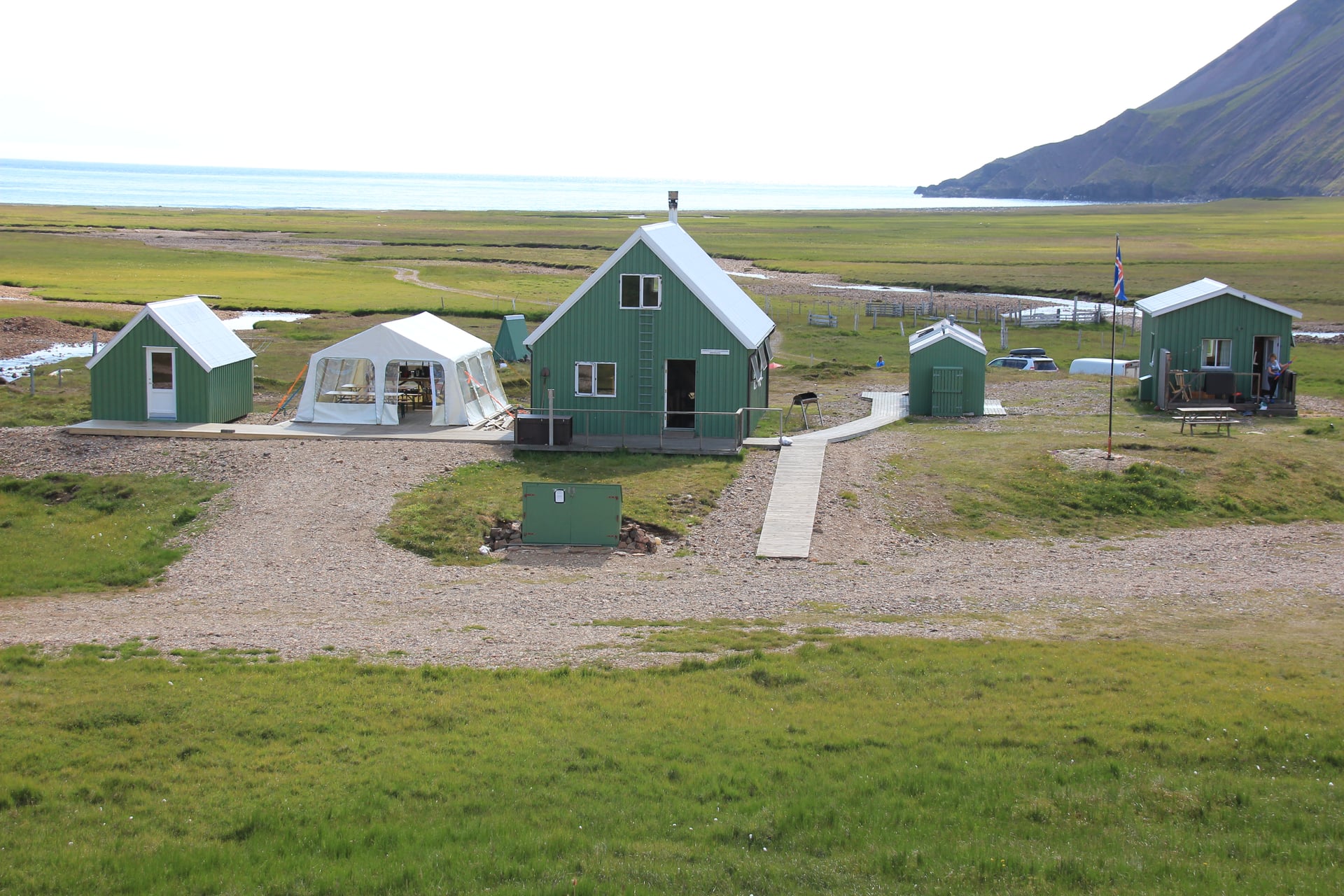
The third Laugavegur hut at 465 meters, around 16 km past Álftavatn through the black-sand desert of Mælifellssandur and into the green mosses near the Markarfljót gorge. The cluster at Botnar is three small huts of 20 beds each, set on a small rise above the canyon, with views toward Eyjafjallajökull and Mýrdalsjökull when the clouds lift.
Each hut runs on the same plan: a small entrance, a bunk room, a corner kitchen with a gas stove and cold running water. The huts share a toilet house with paid showers.
The short side trip to the Markarfljót canyon edge from the hut — about 1 km out and back — is one of the trip's quiet highlights, a slot canyon that very few people photograph because everyone's too tired by Day 3 to walk further.
Fimmvörðuháls Hut (Baldvinsskáli)
Capacity: 16
Altitude: 900m
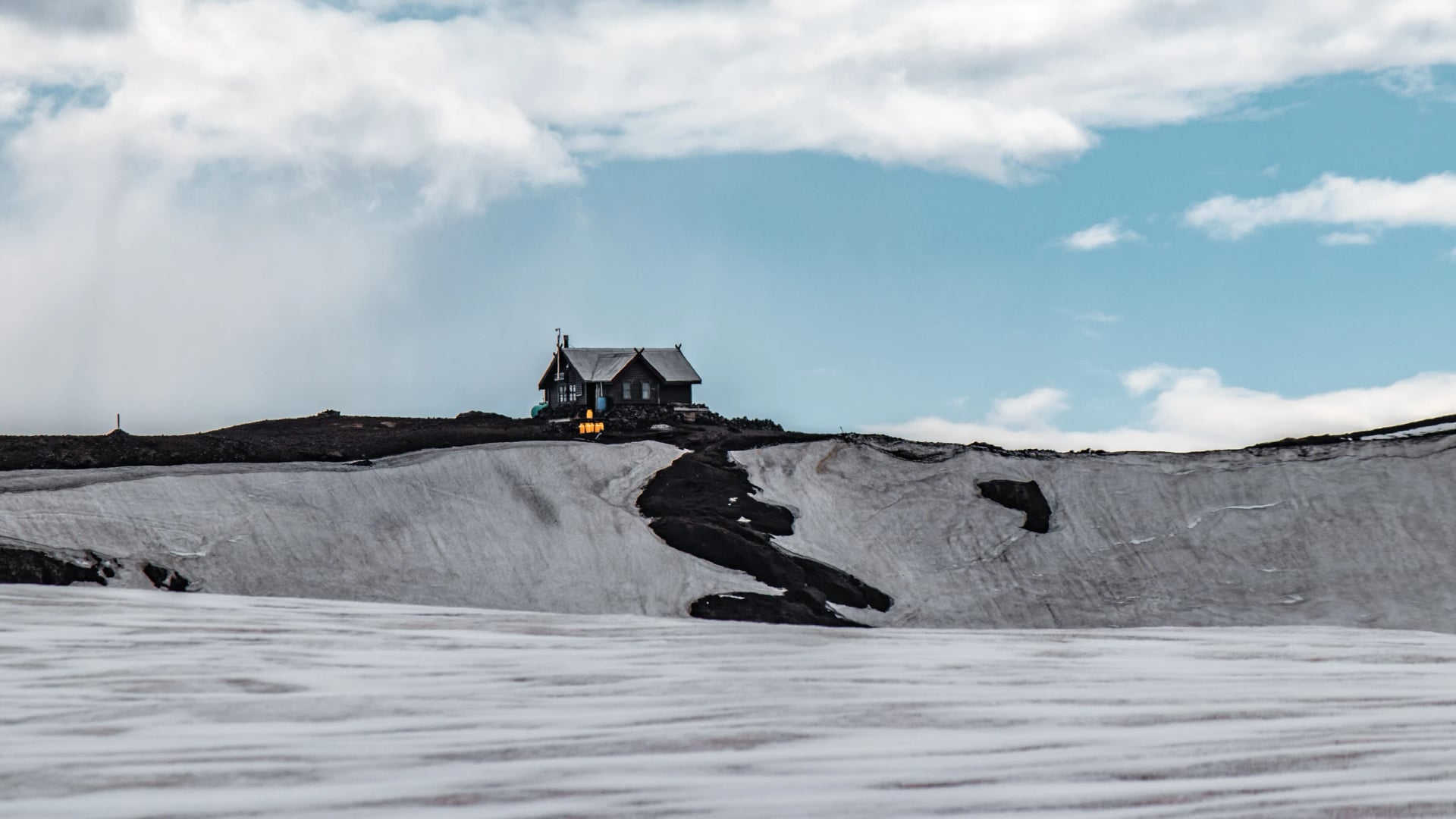
The high hut on the Fimmvörðuháls pass between Skógar and Þórsmörk, sitting on the saddle between the Eyjafjallajökull and Mýrdalsjökull glaciers. The hut is small, basic, and entirely about location — a rough wooden building in a saddle of black volcanic rock, with the Eyjafjallajökull ice cap on one side and the lava field of Goðahraun on the other.
There are bunks, a gas stove, running water for the kitchen and dry, latrine-style toilets.
The hut exists because the Fimmvörðuháls pass is roughly 25 km and around 1,000 m of climbing in a single day, and breaking it into two days is dramatically more pleasant than gunning it through. Booking it for a one-night stop is the easy way to walk the route at a sensible pace.
Húsavíkurskáli
Capacity: 33
Altitude: ~10m
The middle hut on the Víknaslóðir circuit, in Húsavík bay (not to be confused with the whale-watching town of the same name on the north coast). This Húsavík was a working farm and fishing settlement until the mid-twentieth century; today the bay is empty except for the hut and the ruins of the old farm.
It has running water, a shower and toilets, a gas cooking stove, and a wood stove for heating. Expect the same basic setup as Breiðavík.
Like Breiðavík, the appeal is the location and the silence. The hut sits on a low rise above the beach, the sea a few minutes' walk away, and the landward slopes rise into the mountains that rim the trail. A quiet stop on a quiet trail, run by the Ferðafélag Fljótsdalshéraðs section of FÍ.
Loðmundarfjörður
Capacity: 38
Altitude: 10-20m
The eastern terminus of the Víknaslóðir trail (or its start, if you're walking the other direction). The hut at Loðmundarfjörður sits in a long, dramatic fjord that has been almost uninhabited since the late twentieth century, with a small church still standing at the head of the valley and a road that connects only seasonally.
The hut itself is simple — bunks, a kitchen, a wood-burning stove that someone usually has running by the time you arrive.
Reaching the hut on foot means hiking over a high pass from Húsavíkurskáli; for travelers ending the trail here, a vehicle pickup can be arranged through local operators or pre-booked transfers.
Básar
Capacity: 71 (two huts, 55 + 16)
Altitude: ~260m
Útivist's hut at Básar, on the Goðaland side of Þórsmörk just south of the Krossá river. For most Laugavegur and Fimmvörðuháls hikers, this is the trip's ending point — a hut group set in birch woods with views across the river to the green hills of Þórsmörk proper.
Of all the huts in this list, Básar is the most social. It's where day-walkers, multi-day trekkers, and 4×4-tour passengers all converge in late afternoon, where the buses to Reykjavík fill up in the afternoon, and where the kitchen at 19:00 has people from six countries cooking in parallel.
Honorable mention: Guesthouse Rauðafell
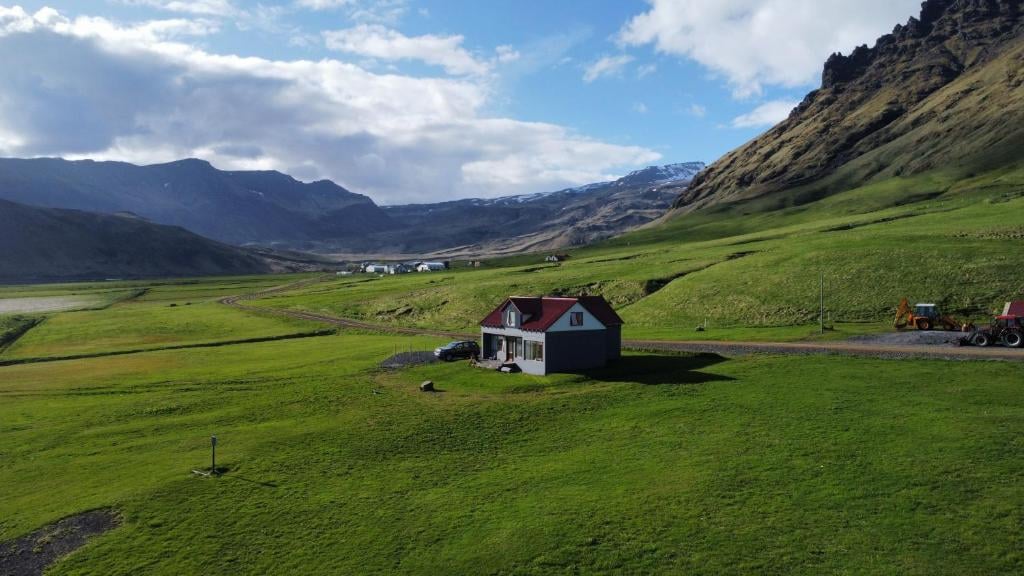
Not a hut in the FÍ sense, but a comfortable guesthouse on the south coast that we use as a soft-landing accommodation for tours that don't run the full hut chain or as a final accommodation before returning to the capital for the flight back home.
Rooms are private, breakfast is included, and the location below the Eyjafjöll glaciers makes it a useful base for day hikes that don't pin you to a dorm bunk for the night. People who read "Iceland mountain huts" sometimes mean exactly this — basic but private accommodation in remote places — rather than the dormitory huts of the highland trails. Rauðafell is the right answer for that profile, and it features in our tours for that reason.
Who Runs the Huts
The largest hut network in Iceland is run by the Icelandic Touring Association (Ferðafélag Íslands —FÍ), a nonprofit founded in 1927 that today operates 40 huts across Iceland. If you've heard of huts on the Laugavegur, on Hornstrandir's edges, or in Þórsmörk's main valleys, you're likely hearing about FÍ properties. Their wardens, mostly volunteers in summer, are part of why those trails work as well as they do — they hold the bookings, manage the kitchens, and know the day's weather better than any forecast.
The second network is Útivist, a smaller association founded in 1975, which runs seven huts, including the ones on the Fimmvörðuháls pass — Baldvinsskáli at the high col, and Básar at the Þórsmörk end on the Goðaland side.
A handful of huts are managed by farms, regional touring clubs, or private operators.
In practice, most standard multi-day Icelandic hikes in the highlands usually rely on FÍ huts. Regardless of the hut owner, rules and standards are broadly similar across all of them.
Booking a Mountain Hut
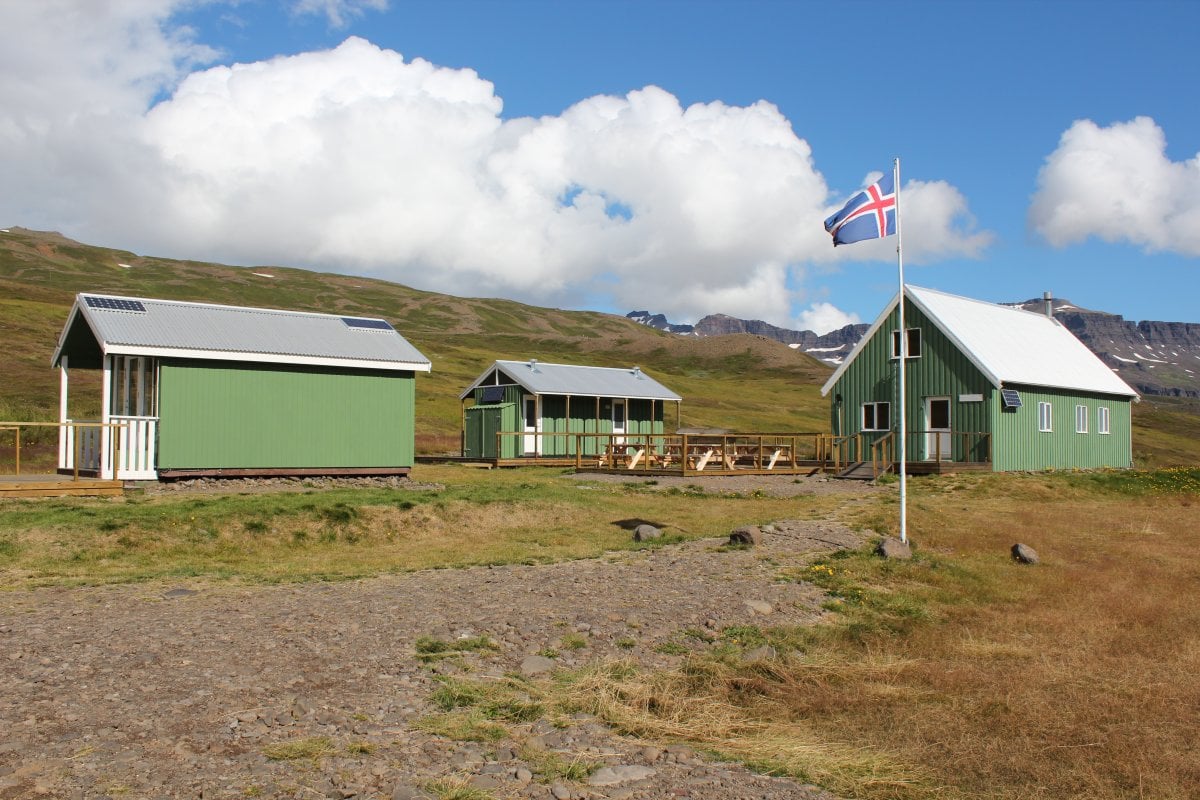
You book directly through the operator: FÍ, Útivist, and the relevant regional or private sites for everything else. Each booking is a specific bunk in a specific hut on a specific night, paid in full at the time of reservation. Refund policies are strict; cancellations are typically nonrefundable inside a few weeks of the date, so build the route before you commit.
FÍ, and Útivist huts are similar in price, with the prior offering a discount for FÍ members. Camping at a hut site, where permitted, is meaningfully cheaper, though it requires you to carry a tent and a full sleep system.
Walk-in availability happens but is unreliable. The wardens may have a no-show bunk, or they may not. If you're flexible on dates and traveling outside peak season, you can sometimes piece a route together this way; in July and August, you cannot count on it.
Book Through Us
Iceland's hut bookings are not technically difficult — every hut takes online reservations, every operator publishes availability, and the wardens are uniformly helpful — but they are a challenging part of planning.
Multi-night routes require chained bookings, nonrefundable deposits, and decisions about which direction to walk a trail before knowing the weather.
If you'd rather hand the bookings off — bunks reserved across the route, transfers timed to bus schedules, GPS trails for the day-by-day, and a number to call if a hut is suddenly unavailable — that's what our self-guided tours are for.
For any further questions about booking or for help with choosing the right trail, feel free to get in touch. We will be happy to help.


HASSLE FREE
We handle itineraries, accommodations, and anything else you prefer not to deal with, so you can enjoy a carefree hike.

BOOK WITH CONFIDENCE
We are a financially protected company, fully bonded and insured, keeping your money safe and allowing you to travel with confidence.

TRIED & TESTED ADVENTURES
Only the best hut to hut hikes in the USA, cherry-picked by our local team with an in-depth knowledge of the region.

UNBEATABLE SUPPORT
Our 24/7 customer support is where we show our passion, bringing you a better experience by making your well-being our number one priority.